
The Day a Little Girl Faced the Judge
The courtroom had never been this full. Every bench was taken, people stood along the walls, and even the clerk had stopped shuffling papers to watch. They all went quiet at the exact same moment—when a tiny girl with tangled brown hair stepped away from the front row and started walking toward the judge’s ben
Her shoes were too big and squeaked softly on the polished floor. Her faded blue dress hung off her shoulders like it had once belonged to someone older and bigger. She looked like she should be in kindergarten, not standing in the center of a courtroom in Maple Ridge, Ohio.
Behind the bench sat Judge Helena Cartwright in her wheelchair, hands resting on the armrests that had held her for the last three years. In two decades on the bench, Helena had seen almost everything—angry outbursts, desperate pleas, people fainting, people cheering. But she had never seen a five-year-old march straight toward her with that kind of purpose in her eyes.
The child stopped right at the base of the bench and tipped her head back. Her eyes were a bright, startling green, full of something that didn’t look like fear at all.
“Judge lady,” she called up, her voice clear enough to reach the very back row, “if you let my daddy go home, I promise I’ll help your legs work again.”
For a heartbeat, the room stayed frozen. Then the noise came all at once.
Someone laughed in disbelief.
Someone else whispered, “Oh, honey, no…”
A man near the aisle let out a low whistle.
Voices rose, disbelieving and confused, bouncing off the high ceiling until the room felt like it was spinning.
But Judge Helena didn’t laugh. Her fingers curled tighter around the armrests as she stared down at the little girl. Something in that small face, something in the way she stood there without shaking, reached past the judge’s training, past the careful wall she’d built around her heart.
She hadn’t felt anything like that in a very long time.
Three weeks earlier, this miracle hadn’t even been a thought. Back then, the story had begun in a cramped second-floor apartment on the other side of town, where a single father named Marcus Dunne was trying to keep his world from falling apart.
A Father on the Edge
Marcus worked the early shift at a small food warehouse on the outskirts of Maple Ridge. He spent his days lifting heavy boxes, checking deliveries, and trying not to think about how quickly his paycheck disappeared.
Every morning, he woke up at 4:30, made oatmeal on an old stove, and woke his daughter gently with a kiss on the forehead.
“Morning, peanut,” he’d whisper. “Breakfast first, cartoons later.”
His daughter, Nora, was the center of his life. She had big eyes the color of green glass and a laugh that filled their tiny apartment. She also had severe breathing problems that seemed to get worse every time the weather turned cold. Some nights, she would sit up in bed, pressing a hand to her chest, pulling in air that wouldn’t quite come.
On those nights, Marcus would sit behind her, hold her upright, and hum old songs into her hair until her breathing steadied again.
The medicine that helped her cost more than he liked to admit. He had sold his car, his watch, and the ring he’d once placed on his wife’s finger. After his wife passed away, it was just him and Nora. Every bill, every prescription, every late notice had his name on it.
One icy Wednesday morning, everything cracked.
Nora woke up flushed and wheezing, her tiny body too warm, her lips pale.
“Dad,” she rasped, “it hurts when I breathe.”
Panic shot through Marcus so fast he had to steady himself on the side of her bed. He pressed his hand to her forehead and felt the heat burning through her skin.
He checked his wallet out of habit, even though he already knew the answer. Three crumpled singles and some coins. The next paycheck was still days away.
He called his supervisor, Mr. Webb, and asked for an advance, voice shaking as he explained.
“Marcus, I’m sorry,” Webb said, sounding genuinely regretful. “You’re one of the good ones, but company policy is company policy. I can’t do it.”
After he hung up, Marcus slid down the wall onto the floor beside his daughter’s bed. He listened to her labored breathing and felt fear settle over him like ice water.
By late afternoon, her fever was worse.
That night, once she finally fell into a restless sleep, Marcus made a choice he had never imagined making in his entire life. He shrugged into his worn jacket, kissed Nora’s warm forehead, and whispered, “I’ll be right back, kiddo. I promise.”
Then he stepped out into the freezing air with his heart pounding and his mind already halfway to the late-night pharmacy on Lincoln Avenue.
The Night at the Pharmacy
The glass doors of Lincoln Pharmacy slid open with a soft whoosh, letting out a wave of heat and the smell of hand sanitizer and laundry detergent. Inside, people walked calmly up and down the aisles: parents buying cough syrup, an older man picking up blood pressure pills, a teenager comparing cold medicine boxes.
Marcus stood just inside the doorway for a moment, his hands shaking—not from the cold this time, but from what he was thinking about doing.
He had never taken anything that didn’t belong to him. Not as a kid. Not as an adult. He paid his parking tickets, returned lost wallets, and taught Nora to say “please” and “thank you.”
But the memory of her small hand clutching his shirt that morning pushed him forward.
He found the children’s fever reducer on the third shelf and the inhaler treatment his daughter’s doctor had recommended the last time they’d been in the emergency room. The price tags blurred together. Two days’ pay, maybe more.
His pulse thundered in his ears as he glanced at the counter. The pharmacist was talking quietly to a woman with a cane. The cashier was turned away, reorganizing a stack of receipts.
Now or never.
Marcus slid the medicine into his jacket pocket as carefully as if it were made of glass. He straightened up, forced his legs to move, and headed for the automatic doors.
He was two steps away from freedom when a hand settled firmly on his shoulder.
“Sir,” a voice said, not unkind but unyielding. “I’m going to need you to stop right there.”
Marcus turned slowly. The security guard was younger than him, with tired eyes and a badge that shone under the bright overhead lights.
“Empty your pockets, please,” the guard said.
For a second, Marcus thought about running. His feet twitched with the urge. But then he imagined leaving Nora alone, waiting for help that never came. He closed his eyes, reached into his jacket, and pulled out the medicine.
“I know what it looks like,” he said, voice breaking. “My little girl is sick. I don’t have enough money until Friday. I wasn’t going to sell this or anything. I just—she needs it now. I’ll pay it back. I swear.”
The guard’s mouth tightened. For a second, it looked like he might bend. Then he shook his head slowly.
“I’m sorry,” he said quietly. “My job is to call the police. That’s the rule.”
Twenty minutes later, red and blue lights flashed against the pharmacy windows. Neighbors watched from the sidewalk as Marcus was led out in handcuffs, his breath fogging in the cold air. He barely heard the officers reading him his rights. All he could think about was Nora alone in their apartment, breathing too fast, waiting for her father to come back with the medicine that never arrived.
The next day, their elderly neighbor, Mrs. Donnelly, found Nora crying in the hallway and took her straight to the hospital. The doctors treated her and made sure she was stable. Then social services stepped in.
By the end of the week, there was an official file with Marcus’s name on it sitting on Judge Helena Cartwright’s desk.
A Judge in a Wheelchair
Helena had once been the kind of woman who never sat down if she could help it. She took the stairs instead of the elevator, danced in her kitchen when a song she loved came on, and spent weekends hiking the hills outside town.
Three years earlier, a truck had run a red light and changed everything.
By the time she woke up in the hospital, her legs were still and silent. The specialists used careful words—“trauma,” “damage,” “unlikely”—while her brother stood in the corner trying not to cry. Eventually, all those careful words settled into one heavy truth: the odds of her walking again were almost zero.
Helena did what she knew how to do. She went back to work.
If she couldn’t change her body, she’d at least control her courtroom. She became known for being exact, steady, and impossible to sway. She read every case file twice, sometimes three times. She listened. She followed the law. She did not make decisions with her heart.
The morning of Marcus’s hearing, the courtroom was packed. Some people had shown up because they worked with him and knew what kind of father he was. Others had come because they believed that stealing was stealing, no matter the reason.
Marcus sat at the defense table in a borrowed jacket that didn’t quite fit, hands tightly folded, eyes red from sleepless nights. He hadn’t seen Nora since the night of his arrest.
The prosecutor, a tidy, serious man named Aaron Feld, laid out the facts in a calm, measured voice.
“Your honor,” he said, “if we start deciding the law no longer applies when a story is sad, we will have no law left at all. Mr. Dunne walked into that store, placed merchandise in his jacket, and tried to leave without paying. That’s theft, plain and simple.”
Marcus’s public defender, Leah Ortiz, did everything she could. She talked about his clean record, the neighbor who had known him since he was a teenager, the stack of hospital bills that had started this chain of events.
Helena listened, her expression neutral. The law was clear. Sympathy didn’t erase facts. She straightened the papers in front of her and prepared to speak.
That was when the heavy courtroom doors creaked open.
Every head turned as Mrs. Donnelly shuffled in, holding the hand of a small girl in a too-big dress.
Nora.
She paused, scanning the room with wide eyes until she spotted her father. Her whole face lit up.
“Daddy!” she cried, the sound ringing through the room.
The bailiff took a step forward to intercept her, but Helena lifted a hand.
“Let her go,” she said quietly.
Nora ran across the room and flung herself into Marcus’s arms. He caught her like a man who had been underwater too long finally reaching air.
“I’m so sorry,” he whispered into her hair. “I made a terrible mistake.”
She leaned back, studying his face with a seriousness that didn’t fit her age.
“You just wanted me to breathe better,” she said. “I know.”
Around them, people wiped their eyes. Even some who had come to see him punished shifted in their seats, suddenly unsure.
Helena cleared her throat.
“Mr. Dunne,” she began, “I understand why you did what you did. But understanding does not erase the law. There still have to be—”
That was when Nora turned and really looked at the woman in the wheelchair for the first time.
The Promise
Nora’s gaze traveled from the judge’s black robe down to the metal footrests where Helena’s still legs rested. Then higher, to the tired lines around her mouth.
Without asking anyone’s permission, Nora stepped away from her father and walked slowly toward the bench.
The room held its breath.
“Judge lady,” she said, resting her small hands on the edge of the polished wood, “my dad is a good dad. He only took that stuff because I was really sick and he was scared.”
Helena leaned forward slightly. “I’ve read all about that, Nora,” she said gently. “I know he loves you. But he still broke the law.”
Nora nodded as if that made perfect sense. Then she did something that made absolutely none.
She reached up and touched Helena’s hand.
“Your legs don’t work and that makes you sad inside,” Nora said, her voice as calm as if she were pointing out the weather. “I can feel it. My dad says sometimes when people are hurt, they can’t see all the love around them anymore.”
A strange, warm pressure bloomed in Helena’s chest. For a split second, she almost pulled her hand away. Instead, she stayed still.
“I have a gift,” Nora went on quietly. “I help people feel better when something inside them is broken. If you let my dad go home with me, I’ll help your legs remember what to do.”
For one long, charged second, nobody moved.
Then the room exploded.
“That’s ridiculous.”
“She’s just a child.”
“Somebody get her away from the bench.”
The prosecutor stood up so fast his chair almost tipped over. “Your honor, this is completely inappropriate. We can’t—”
Helena grabbed her gavel.
“Order!” she snapped, the sound cracking through the chaos. “Order in my courtroom.”
The voices gradually died away.
“Nora,” Helena said, forcing her own voice to stay steady, “every doctor I’ve seen has told me the same thing. My injury is permanent. What you’re saying…it simply isn’t possible.”
Nora smiled, her whole face lighting up.
“Sometimes doctors don’t know everything,” she said simply. “Sometimes things change when people remember how to hope again.”
She let go of Helena’s hand and stepped back.
“I’m not asking you to believe right now,” she added. “Just give me a chance. Let my dad come home. I’ll show you.”
Helena looked at the little girl, then at Marcus, then at the waiting crowd. Her training told her this was nonsense. Her experience told her that people promised impossible things in court all the time.
But her heart, which had been quiet for three years, was whispering something else: what if?
What if this child didn’t heal her legs at all—but healed something else inside her that had been asleep since the accident?
Helena took a slow breath that seemed to come from somewhere very deep.
“Young lady,” she said, “a promise is a serious thing. Are you sure you understand that?”
“Yes, ma’am,” Nora replied. “I don’t break promises.”
“And you truly believe you can help me walk again?”
Nora’s answer was immediate. “I don’t just believe it,” she said. “I know it.”
Helena’s heart beat harder. She turned to Marcus.
“Mr. Dunne,” she said, “under ordinary circumstances, I would be sentencing you today. However, your daughter has made…a proposal.”
A startled murmur swept the room.
“I am going to do something I have never done before,” Helena continued. “I’m postponing your sentencing for thirty days. If, during that time, Nora can keep the promise she has made to this court, I will dismiss the charges against you.”
The prosecutor shot to his feet. “Your honor—”
“In thirty days, Mr. Feld,” Helena said sharply, “we’ll either have proof that this was all foolishness or proof that something remarkable has happened. Until then, Mr. Dunne, you are released to go home with your daughter.”
Marcus stared at her, stunned. Then joy broke across his face—until Helena lifted a hand.
“There is one more condition,” she said. “If Nora cannot keep her promise, you will return here to face the full charges, plus additional consequences for encouraging your child to make statements to the court that were not true. Do you understand?”
The hope in Marcus’s eyes faltered. This was not just a gift; it was a risk.
Before he could answer, Nora slid her hand into his.
“Don’t worry, Dad,” she whispered. “We’ve got this.”
Helena watched them walk out of the courtroom together, hand in hand, while the crowd erupted into whispered arguments.
Some people thought she had lost her mind.
Some thought they had just witnessed the beginning of something extraordinary.
Helena wheeled back into her chambers afterward and sat alone in the quiet.
For the first time in three years, she realized, she was looking forward to tomorrow.
Ducks, Dancing, and a Sleeping Spirit
The following morning, Helena woke before her alarm. Sunlight slipped through the blinds in thin stripes, laying patterns across her blankets. In spite of herself, she wondered what Nora was doing.
Was the little girl sitting at a kitchen table eating cereal? Was she already thinking about how to keep a promise that seemed impossible?
Across town, Marcus watched Nora finish her toast as if nothing unusual had happened at all.
“Nora,” he said carefully, “about what you told the judge…”
“I know,” she said, swinging her legs under the chair. “You’re scared because you can’t see it yet.”
“Sweetheart, you’ve never helped someone with something this big,” he said. “Helping a sore back or cheering up a friend is one thing. This is…” He stopped himself before he said too much.
Nora tilted her head. “Do you remember when Mrs. Donnelly hurt her back and couldn’t get out of bed?” she asked.
“I remember,” Marcus said.
“I sat with her and told her stories and held her hand, and the next day she said it felt like someone had taken a heavy stone off her.”
“And Tommy downstairs,” she added, “with his broken wrist. I drew him that superhero picture, remember? The doctors said it would take a long time, but it got better faster than they thought.”
Marcus did remember. He’d thought it was coincidence, or maybe just the power of kindness.
“Nora,” he said quietly, “helping someone feel better is wonderful. But making legs move again when everyone says they can’t…”
She wiped a bit of jam from her chin and looked at him with those wise green eyes.
“Dad, her legs are quiet because her heart is tired,” she said. “When people are sad for a long time, sometimes their bodies forget what to do. I’m going to help her heart wake up. Then her legs can decide what they want to do.”
That afternoon, Helena’s phone rang.
“Judge Cartwright?” a familiar voice said.
“Yes?”
“It’s Nora,” the child chimed in. “Judge lady, can we be friends before I help you? It’s hard to fix something for somebody if you don’t know them.”
Helena blinked, completely thrown. In all her years on the bench, no one had ever asked to be her friend.
“Where would you like to meet?” she heard herself ask.
“Do you know Willow Park?” Nora said. “By the pond with all the ducks? Can you come tomorrow at three? And don’t bring your judge face. Just bring you.”
Helena looked at her calendar. She had planned to review case files. Instead, she found herself saying, “I’ll be there.”
The next day, wearing a soft blue dress instead of her robe, Helena wheeled herself down the paved path toward the pond. Nora sat on the grass in a yellow dress, tossing pieces of bread into the water. Marcus watched from a nearby bench, his eyes never leaving his daughter.
“Judge Helena!” Nora called, waving. “Over here!”
Helena joined her at the water’s edge. Nora poured some breadcrumbs into her hand.
“The ducks like people better when they share,” Nora said matter-of-factly.
For almost an hour, Helena did something she hadn’t done in years. She fed ducks. She listened to Nora give every duck a name and personality. She laughed when one particularly brave duck decided Helena’s wheelchair might be a good place to search for more food.
After a while, Nora wiped her hands on her dress and looked up.
“Judge Helena, can I ask you something?”
“Of course,” Helena said.
“Before your accident, what did you love doing the very, very most?”
Helena stared across the pond, watching the light ripple over the water. “I loved dancing,” she said at last. “I took lessons when I was little. As a grown-up, I’d put music on in my kitchen and spin around like nobody was watching.”
“Do you miss it?” Nora asked softly.
“Every day,” Helena answered, her throat tight.
Nora stood and held out her hand.
“Want to dance with me?”
Helena let out a sad little laugh. “Nora, I can’t stand up.”
“You don’t have to stand up to dance,” Nora said. “Your arms can dance. Your head can dance. Your heart can dance. Watch.”
She lifted her arms and began to move them slowly, like waves in the air. She turned in a small circle, her steps tiny, her face relaxed and happy.
“See?” she said. “I’m barely moving my feet. But I’m still dancing.”
Something inside Helena trembled. Without fully deciding to, she raised her own arms, copying the gentle motion. She rolled her shoulders, tilted her head. The rhythm was clumsy at first, then easier.
“You’re dancing,” Nora said, grinning. “You’re really dancing.”
Helena felt tears slip down her cheeks, surprising and warm. For the first time in three years, she didn’t feel like only the woman in the wheelchair. She felt like herself.
“How do you feel?” Nora asked.
“Alive,” Helena whispered. “I feel alive.”
Nora stepped closer and laid her hands softly on Helena’s knees.
“Your legs are sleeping,” she murmured. “They’re not broken inside like everyone says. They’ve just been waiting for your heart to wake up all the way.”
Helena swallowed hard. “And you think you can wake it?”
Nora smiled. “I think it’s already starting,” she said. “Come back tomorrow? We’ll feed the ducks again. We’ll dance again. And I’ll tell you all the beautiful things you forgot were still waiting for you.”
Helena rolled away from the pond later that afternoon with something new growing quietly inside her: steady, gentle, stubborn hope.
None of them knew that by that evening, that hope would be tested more fiercely than any of them expected.
The Fall and the Test
The call came just as Marcus was chopping vegetables for dinner.
It was Mrs. Donnelly, voice tight with worry.
“Marcus, they just took Judge Cartwright to the hospital,” she said. “Somebody said her wheelchair tipped by the pond. They think she hit her head.”
Marcus felt the knife slip in his hand. “Is she—” He couldn’t finish the sentence.
“They don’t know yet,” Mrs. Donnelly said. “They said it’s serious.”
Marcus looked over at Nora, who was coloring at the table. She watched him calmly, as if she already knew who was on the phone.
“Dad,” she said after he hung up, “this is the test.”
“What do you mean?”
“She was just starting to feel awake inside,” Nora said. “Getting hurt again scared her spirit, and now it’s hiding. We have to help her find the way back.”
At the hospital, the waiting room was crowded. People from town had come as soon as they heard.
Dr. Miles Carter, Helena’s longtime physician, came through the doors with a grave look on his face.
“Judge Cartwright has a serious head injury,” he said. “She’s unconscious. The next day or so is very important.”
Worried murmurs spread through the room. Marcus felt the floor sway beneath him.
Nora stepped forward.
“Dr. Carter,” she said politely, “can I see her?”
He blinked down at her. “I’m sorry, young lady. Children aren’t usually allowed in that part of the hospital.”
“She needs me,” Nora said. “Her spirit got lost again. I know how to talk to it.”
A few people looked at her with doubt. Others looked at her as if she might be their last thin string of hope.
The prosecutor, Aaron Feld, arrived a few minutes later, still in his suit from work.
“I heard it on the radio,” he said, running a hand through his hair. “I had to come.” His eyes fell on Nora, and something in his face softened. “Doctor, if Judge Cartwright trusted this child enough to risk her career, maybe we can trust her with five minutes.”
Dr. Carter hesitated. He had always believed in charts, scans, and numbers. But at that moment, every pair of eyes in the waiting room was fixed on him.
“Five minutes,” he said quietly at last. “She can go in with her father and with me. That’s all.”
Guiding a Spirit Home
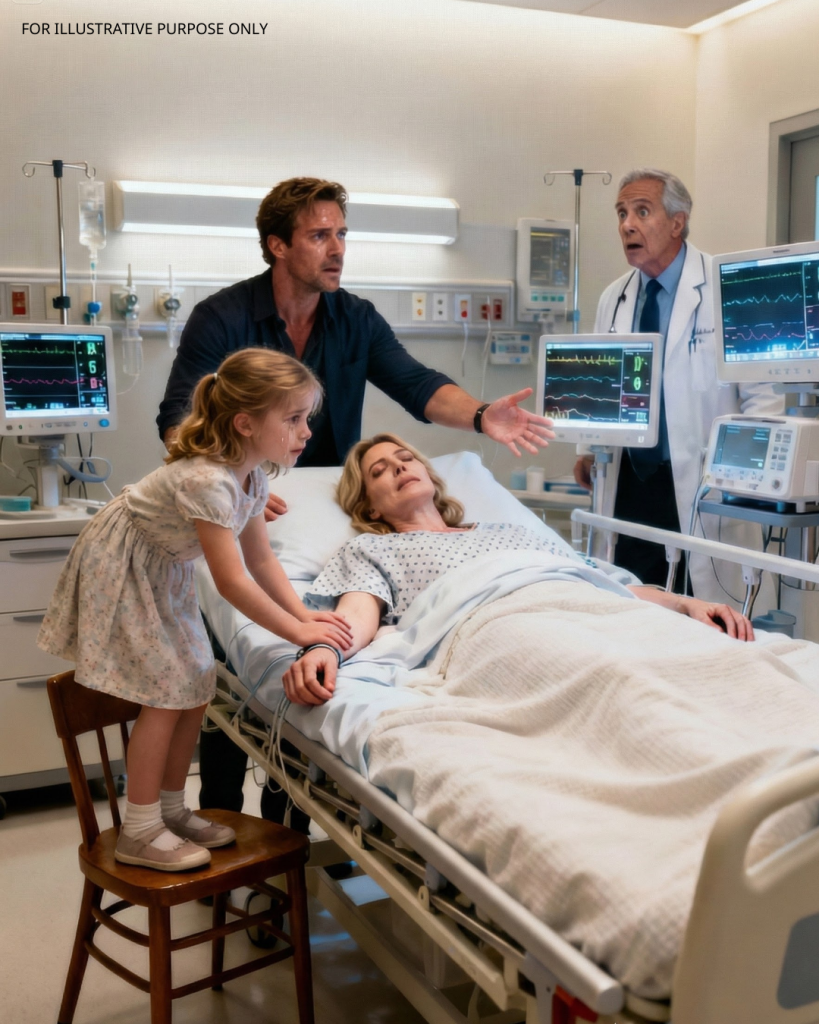
Helena lay in a quiet room full of soft beeping and blinking lights. Tubes snaked from her hands and arms. Her face, usually so composed, looked small and pale against the hospital pillow.
Marcus stayed back near the door while Nora climbed onto a chair beside the bed.
“Hi, Judge Helena,” Nora said softly. “You can’t hear me with your ears right now, but maybe you can hear me with your heart.”
The machines kept up their steady rhythm. Helena didn’t stir.
“I know you’re scared,” Nora continued. “Falling like that felt like the accident all over again, didn’t it? It made your spirit run and hide.”
Dr. Carter watched the monitors, half out of habit, half out of disbelief.
“Remember the pond?” Nora whispered. “Remember how we fed the ducks and danced with our arms? Remember how light you felt for a minute?”
Her small fingers curled gently around Helena’s wrist.
“That light is still there,” Nora said. “It didn’t go away when you fell. It’s just harder to see. So I’m going to help you find it again.”
She closed her eyes and took a deep breath, as if listening for something far away.
“Do you see the path?” she asked quietly. “It’s made of all your good memories. You as a little girl spinning in your living room. You on your first day as a judge, so proud. You laughing when that duck almost stole your bread.”
On the monitor, Helena’s heart rate, which had been sluggish and uneven, steadied slightly.
“That’s it,” Nora murmured. “Follow the light. You are not just a person in a chair. You are brave and kind and strong. You have so much more work to do.”
Helena’s fingers twitched.
Dr. Carter leaned in. “She’s responding,” he breathed.
“Come back to us,” Nora said, her voice firm now. “Not because you promised anything to me. Because this world still needs the way you care about right and wrong. Because you still have dancing to do. Because your story isn’t finished.”
Slowly, Helena’s eyelids fluttered. Then, all at once, they opened.
She blinked at the overhead light, then turned her head toward the small warm weight holding her wrist.
“Nora?” she whispered, her voice hoarse. “Where…?”
“You’re at the hospital,” Dr. Carter said, moving quickly to check her responses. “Your chair tipped at the park. You’ve been out for a while.”
Helena listened, trying to chase down the fading edges of the strange, bright dream she’d just had—a path of light, a small hand in hers, a voice that wouldn’t let her give up.
“It wasn’t just a dream,” Nora said quietly, as if she’d heard her thoughts. “You were lost. We found you.”
Dr. Carter ran through his questions.
“Can you tell me your name? The year? Who’s in the room with you?”
Helena answered them all without hesitation. Her mind was clear.
“How do you feel?” he asked.
She surprised herself with her answer. “Hopeful,” she said honestly. “More than I have in a long time.”
As she shifted in bed, a strange sensation washed over her legs—like pins and needles after sitting too long. She went very still.
“Doctor,” she said slowly, “I can feel something.”
“Sometimes, after a head injury—”
“No,” she cut in. “Not imaginary. Real.”
She focused, sending every bit of willpower she owned downward. Under the blanket, her right foot moved. Just a little, but enough.
The room went absolutely silent.
Then her left foot twitched.
Dr. Carter stared, speechless. “This doesn’t make sense,” he said, almost to himself. “The scans, the damage—we talked about this so many times. It wasn’t supposed to be possible.”
Helena’s eyes filled with tears. She looked at Nora.
“Did you…?”
Nora shook her head gently. “We did,” she said. “Your spirit just needed someone to walk beside it until it remembered how to stand up again.”
A New Kind of Justice
In the weeks that followed, physical therapy sessions became the center of Helena’s schedule. There were setbacks and pain and days when her muscles shook with effort. But every week, her steps grew steadier.
Nora visited whenever she could. She told jokes in the waiting room, drew pictures of dancers, and reminded Helena of their “duck dances” whenever the judge felt discouraged.
By the time the thirty days were almost up, Helena could walk short distances with a cane. The first time she crossed a room on her own, the therapists clapped. Helena didn’t cry until later, when she was alone and letting it finally sink in.
On the day Marcus was due back in court, the building was filled long before the hearing was scheduled to start. Word had spread. People wanted to see, with their own eyes, what everyone in town had been talking about.
“All rise,” the bailiff called.
The courtroom stood—and then a ripple of awe moved through the room.
Instead of rolling to the bench, Helena walked in slowly, leaning on a dark wooden cane, her black robe flowing around her legs. Her steps were careful but firm.
Somebody gasped. Someone else started clapping, then seemed to remember where they were and stopped.
Helena reached her seat, turned, and sat down, her face calm but glowing with quiet joy.
“In the matter of the State versus Marcus Dunne,” she said, her voice steady, “we have unfinished business.”
Marcus stood at the defense table, Nora’s hand tucked in his.
“Mr. Dunne,” Helena continued, “the last time you were here, I postponed your sentencing based on a promise your daughter made.”
A low murmur swept the room as she set the cane beside her chair, in clear view of everyone.
“In the last month, I have experienced something every specialist in my life told me was out of reach,” she said. “I have regained feeling and movement in my legs. The medical reports do not explain it fully. The only explanation that makes sense to me is this: somewhere between my head and my heart, I started to believe again.”
She looked straight at Nora.
“And a very brave little girl walked beside me until I did.”
Helena turned back to Marcus.
“You did commit a crime that night. The facts are not in dispute. But the law also gives judges room to consider intention, harm, and the greater good.”
She paused, letting the room settle.
“I am dismissing the charges against you,” she said clearly. “Instead, I am recommending you for a position at the medical center’s facilities department. They’ve been looking for someone steady and hardworking. The job comes with full health coverage for you and your daughter. I will personally make the call.”
Marcus’s mouth fell open. “Your honor,” he said, voice breaking, “I don’t have words.”
“Then don’t use any,” Helena replied gently. “Just take care of Nora. And remember that needing help once doesn’t make you a bad man. It makes you human.”
She glanced at the prosecutor.
“Mr. Feld, I know this is not the outcome you argued for,” she said.
He gave a small, almost sheepish smile. “Your honor, I came here ready to protest. Then I saw you walk in. I think I’m just…grateful to have been wrong.”
Laughter rippled softly through the room.
When Miracles Spread
Three weeks later, Helena walked into her courtroom with an easier stride. She still kept her cane close, but her movements had a confidence that hadn’t been there before.
Before beginning the day’s docket, she rested both hands on the bench and addressed the full room.
“Something happened in this courtroom a month ago,” she said. “A little girl reminded me that justice is not just about punishment. It’s also about mercy, courage, and the willingness to believe that people can change.”
Her gaze found Nora, sitting in the front row in a bright dress, swinging her feet above the floor.
“She reminded me that healing isn’t always about fixing a body. Sometimes it’s about fixing the way we see ourselves.”
The months that followed brought more changes. Helena still followed the law, still read every file carefully. But now, when someone stood in front of her with a story about desperation and love, she listened with both her head and her heart.
Six months after Nora first touched her hand, Helena stood in a softly lit reception hall holding another hand—Dr. Carter’s—as music played and guests watched.
Her dress brushed the floor as she moved. Her steps were careful but sure.
“It’s not perfect,” she whispered to him with a smile, “but it’s dancing.”
“It’s beautiful,” he answered.
At the front table, Marcus sat beside Nora. She was scattering rose petals she’d saved from earlier, humming to herself.
“Dad,” she said, leaning close, “do you know the best thing about miracles?”
“What?” he asked, watching Helena turn slowly under the lights, laughter on her face.
“Once people see one happen,” Nora said, “they start believing little good things can happen all the time. And when they believe that, they treat each other better. That’s kind of like more miracles, just smaller.”
Marcus slipped an arm around her shoulders and held her close.
He thought about the night he’d walked into the pharmacy with shaking hands. He thought about a courtroom where his future had been hanging by a thread. He thought about a woman who had gone from feeling trapped in a chair to dancing in the arms of someone who loved her.
Maybe miracles looked like sudden, impossible changes. Maybe they also looked like a neighbor stepping in when things fell apart, a doctor keeping his mind open, a prosecutor changing his opinion, a judge daring to hope.
And maybe, most of all, they looked like a little girl with green eyes and a quiet, unshakable belief that love could do things no one could explain.