
The Morning Everything Broke
The sun over Lake Michigan bounced off the glass towers outside our condo, turning the windows into hard, bright rectangles. It wasn’t gentle light—it was the kind that made every streak on the glass and every line under my eyes stand out. When I caught my reflection in the bedroom mirror, I almost didn’t recognize myself.
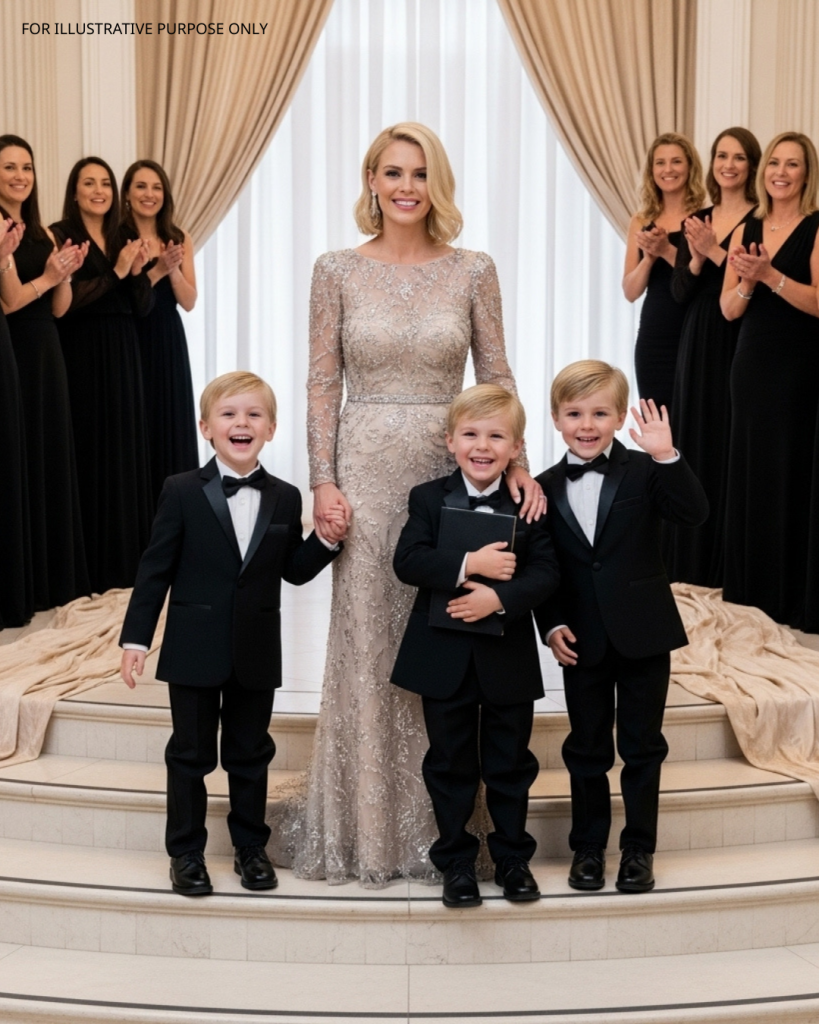
My name is Grace Miller. I was twenty-nine years old, six weeks after delivering our triplets, and some mornings I felt closer to fifty. My body still hadn’t caught up to what had happened: my belly softer than I was used to, a pale line running down to the scar from the emergency surgery that brought my three boys into the world, faint silver marks tracing where my skin had stretched to make room for them. My back ached from hours of rocking and feeding; my head pounded from too many nights broken into fifteen-minute pieces.
The condo—three thousand square feet high above downtown Chicago—was crammed with bassinets, cases of formula, boxes of diapers, and a rotating army of baby gear that never quite seemed like enough. It didn’t feel like a luxury apartment anymore. It felt like a busy nursery with a view.
That morning, I stood there in milk-stained pajamas at nearly ten o’clock, my hair pulled into a crooked bun, one son at my shoulder and two tiny shapes visible on the monitor beside the bed. I was gently bouncing, trying to keep one baby from crying and silently begging the other two to stay asleep a little longer. My hands trembled from tiredness and too much coffee.
That was the moment my husband chose.
A Husband in a Perfect Suit
The bedroom door opened without a knock.
Caleb Hart stepped in like he was walking onto a stage. Dark tailored suit, crisp white shirt, tie knotted just right. He was the co-founder and public face of Horizon Meridian, a high-profile investment firm that loved glossy magazine covers and business podcasts. His watch cost more than my first car. He smelled like expensive cologne and starch and a life untouched by spit-up.
He didn’t look at the monitor. He didn’t look at the baby on my shoulder. His gaze moved straight to me, sliding slowly from my tangled hair to my slippers. His eyes didn’t soften when they passed over the scar beneath my shirt or the circles under my eyes. They hardened.
He dropped a thick folder on the bed. The sound was sharp in the quiet room, louder than a knock. I didn’t need to read the first page to understand what it was. The words “Petition for Dissolution of Marriage” were printed neatly on the tab.
I stared at the folder, then at him, my mind struggling to keep up.
“Grace,” he said, his voice the same one he used on earnings calls, cool and polished, “look at yourself.”
I did. Pajamas that had seen better days. Hair I hadn’t washed. A small stain on my shoulder where one of the boys had spit up hours earlier. The faint outline of my compression garment under my shirt, still holding my abdomen together while I healed.
“You look like some kind of stringy scarecrow,” he went on, shaking his head. “You’ve let everything go. You drag yourself around this place with no energy, no effort. And I can’t have that standing next to me. Not now. Not with everything on the line.”
I swallowed hard, my throat dry. “I just carried three children,” I said quietly. “Your sons. Six weeks ago.”
“And you chose to turn yourself into this in the process.” He adjusted his cufflinks, as if the conversation bored him. “I didn’t sign up for a life where my wife disappears into baby chaos and forgets she’s supposed to represent us. My partners expect a certain image. Our clients expect a certain image. I need someone who reflects that. Not someone who looks like she’s falling apart.”
The baby at my shoulder squirmed, sensing my tension. I shifted him automatically, my hands moving on instinct even while my heart clenched.
Caleb took a breath like he’d rehearsed what came next. “I’ve already moved on,” he said. “It’s better for everyone.”
The Woman in the Doorway
He glanced toward the hallway. I knew before she appeared that this was not a conversation; it was a performance.
Jenna Cole stepped into the doorway, hand resting lightly on the frame as if she’d practiced that pose. She was twenty-three, his executive assistant at the firm. Long hair styled in smooth waves, flawless makeup, a fitted navy dress that screamed “polished professional” and “I have time to sleep” at the same time.
I remembered the day he hired her. I remembered the way he’d said, “I need someone sharp, someone who understands image,” and how his eyes had lingered a second too long on her résumé photo. I remembered telling myself I was imagining it.
Now Jenna’s mouth curved into a small, careful smile when she looked at me. The kind of smile that said she already knew everything and had no intention of pretending otherwise.
“We’re heading to the office,” Caleb said, already reaching for Jenna’s briefcase as if this was any ordinary morning. “My attorneys will handle the paperwork. You can keep the house in the suburbs—the one with the yard. It makes more sense for you now.”
“The house in Oakfield?” I asked, my voice catching on the name of the little town outside the city where we’d planned to raise our boys.
He shrugged. “You like quiet anyway. And honestly, I’m done with the crying and the hormones and the mess. This place”—he gestured around the condo—“isn’t a family home; it’s my base. It needs to look like it.”
He slid an arm around Jenna’s waist like he was completing a transaction. It was so smooth, so practiced, that for a moment I wondered how long he’d been doing it.
The message was clean and brutal: I no longer fit the brand.
They left without another word. Jenna’s heels clicked on the hardwood, then the front door closed with a firm, final sound. The condo fell into a strange quiet, broken only by the soft static of the baby monitor and the small, sleepy noises of my sons.
Caleb walked out absolutely sure that I would be too tired to resist, too financially dependent to argue, and too worn-down to remember who I’d been before his world swallowed mine.
Finding the One Thing He Didn’t Own
For a long minute, I stood in the middle of that bedroom, baby on my shoulder, my eyes fixed on the divorce papers. My heart was beating so hard my chest hurt, but there was another feeling too—something under the hurt, something steady and surprisingly clear.
Before I married Caleb, I hadn’t belonged to skyline views or charity galas or financial headlines. I had belonged to words.
In my early twenties, I’d been a young writer who believed in her own sentences. I’d studied creative writing at a state university, published a couple of short stories in small journals, and dreamed of a first book. Then I’d met Caleb at a networking event I had almost skipped. He’d been charming and confident, talking about market trends and “building something big.” He’d read one of my stories, called it “interesting,” and suggested that once we were married, my “real talent” could be planning events and hosting the people who mattered to his firm.
Little by little, I had set my writing aside. There was never a clear order to stop, just a dozen small comments, a hundred subtle shifts. His travel schedule. His need for me at dinners. My own wish to be supportive. By the time we’d been married seven years, I hadn’t written anything longer than a grocery list in months.
Now, standing there with three tiny sons depending on me, I understood something I hadn’t let myself say out loud: he had taken almost everything from me—time, confidence, the version of myself that had once felt bright and alive. But he had never really understood my mind. And he had no idea what it could do when it was backed into a corner.
The folder on the bed didn’t feel like the end anymore. It felt like permission.
I laid my son gently in his bassinet, watched his chest rise and fall, then picked up the divorce papers and carried them into the kitchen. I didn’t sign them. I set them beside my laptop.
If he wanted to reduce me to a scarecrow, then I would be the kind of scarecrow that stands in the middle of a field through every storm and refuses to fall over. And I would do the one thing he never believed I could make matter: I would write.
Writing Through the Night
My days were shaped by bottles, burp cloths, diaper changes, and short, frantic naps. My nights became something else.
When the night nurse arrived and the boys finally settled into a fragile rhythm of sleep, I opened my laptop at the kitchen counter. The counters were lined with formula containers and sterilized bottles; my coffee mug sat beside the keyboard.
I didn’t write a blog post or a personal essay. I didn’t write a long message asking for pity or validation. I wrote a novel.
I called it The Chairman’s Scarecrow.
On the surface, it was about a powerful chairman of an investment firm who shed his wife after she gave birth to their children because she no longer matched the image he wanted to project. But anyone who knew Caleb could have drawn the lines. I changed names, cities, and company details, but I kept the small, specific truths—the way he checked his reflection in every shiny surface, the brand of whiskey he poured at the end of a long day, the exact shape of his signature on documents he barely skimmed.
I wrote about the pregnancy and the delivery, about the fear in the operating room, about waking up and counting three tiny hands on three tiny chests. I wrote about the loneliness of nights where everyone else slept and I sat awake, listening to three different patterns of breathing and praying they would stay steady.
And then I wrote about the words “stringy scarecrow” spoken in a bedroom full of light. I let the main character hear them, break under them, and then slowly stand back up.
I did not stop there.
Over the years, Caleb had told me more than he realized. Stories from boardrooms, casual comments over dinner about deals that were “aggressive but necessary,” about partners who “would never look that closely,” about regulations that were “flexible if you knew who to call.” In his mind, these were victories. In my book, they became threads in a larger pattern—a portrait of a man who believed every rule could bend for him if he smiled the right way.
Writing the book hurt. Some nights I wrote through tears so heavy they blurred the screen. Other nights, I wrote with a strange, almost calm focus, describing moments of emotional cruelty with the precision of someone taking careful notes.
When I finished the first complete draft, six months had passed. The boys were bigger, smiling, rolling over, grabbing at my hair with clumsy hands. I was thinner but stronger, both from carrying them and from carrying the story.
I sent the manuscript to a publisher under a pen name: L.R. Hayes. I did not attach my real name. I did not mention Caleb. The editor who read it called the next week, her voice full of quiet excitement.
“This is powerful,” she said. “It feels like it comes from somewhere very real.”
“It does,” I replied. “I just can’t be that real. Not yet.”
We signed a contract that favored speed over a huge advance. I wasn’t looking for a giant check. I was looking for a release date.
When Fiction Stops Feeling Like Fiction
The book came out on a Tuesday in early fall. It slipped into the world without banners or billboards, just a few online posts and a short review in a literary blog. For a few weeks, it lived in the quiet corners of bookstores, sold to readers who liked stories about complicated marriages and powerful men who weren’t as untouchable as they thought.
The early reviews were kind. People called it honest, sharp, haunting. Some wrote that they’d never seen emotional disregard described so plainly. The sales were steady, not explosive. It was enough. I was content knowing that my story had left the walls of our condo and landed in other minds.
Then a journalist at a financial magazine picked it up on a flight.
She read late into the night, her curiosity growing with each detail—a high-rise condo in a Midwestern city, an investment firm with a certain type of culture, triplets born to a wife who was then discarded. She had recently covered a small item about a high-profile partner in Chicago going through a quiet divorce while preparing for a big expansion. The rhythms matched.
Within days, she published a long article laying out the parallels. She never said, “This is exactly Caleb Hart,” but she asked the question in a way that didn’t need an answer: What if this story isn’t just a story?
The internet did the rest.
Readers began buying the book not only for the writing, but to look for clues. People posted highlighted passages online, lining them up next to news articles about Horizon Meridian. A phrase from the book about a charity gala held in a museum matched an old fundraiser photo of Caleb. A detail about a particular custom watch matched one he wore in an interview.
Suddenly, The Chairman’s Scarecrow was everywhere. It climbed the bestseller lists in a matter of days. Book clubs, podcasts, and talk shows started discussing it—not as abstract fiction, but as a mirror held up to a certain kind of man who valued image more than people.
Caleb’s name began appearing in the comments. Then in opinion pieces. Then in panel discussions on business channels.
He went on television once to respond, insisting the whole thing was a work of imagination written by “someone who clearly has an issue with successful men.” He smiled in a way that used to charm investors. On screen, it looked thin. The clip spread across social media, and the comments were not kind. People kept replaying the part where he brushed off the idea that emotional harm in a marriage “wasn’t a real problem.”
Investors watched. Partners watched. And so did the people who regulate money.
Watching His World Shrink
I did not see the board meeting where it all came apart, but I heard enough versions of it to picture it clearly.
Horizon Meridian’s directors sat around a long table while charts and graphs flashed on the screens behind them. The firm’s name had been dragged into every conversation about the book. Clients were nervous. Some had already stepped back from deals. Young talent had turned down job offers, not wanting to be tied to a firm that felt careless with people.
Caleb tried to enter the room and was stopped by security. Later, one of the assistants told a friend of a friend that she had never seen him look so stunned.
The board called him from inside the room. They spoke calmly, in the same careful tone he had once used with me when he wanted to end an argument without looking angry. They told him that his presence had become a “liability for the firm’s reputation and long-term stability.” They thanked him for his role in building the company and informed him that they were ending his contract for cause.
He argued, raised his voice, pointed to what he had built. He blamed me without saying my name, called the book unfair, called the public reaction exaggerated.
It didn’t matter. The story had become bigger than him.
Regulators started asking questions too. Some of the “creative” practices I had described in the book gave them ideas about where to look. Numbers that had once seemed impressive now looked too good. Deals that once appeared clever began to raise quiet alarms.
Every headline that mentioned Horizon Meridian now carried a second line, one that connected back to me—back to the story that had started on a kitchen counter while three babies slept down the hall.
Courtrooms and Quiet Triumphs
All of this swirled around us while the divorce slowly moved through the official steps.
By then, The Chairman’s Scarecrow was a bestseller. My pen name was on lists I’d only ever dreamed of reading, much less appearing on. My lawyer walked into court with a file full of articles, interviews, and statements Caleb himself had given. She knew the judge had likely heard of the book and seen at least one of those segments.
The book itself wasn’t evidence, but the pattern it described lined up with real messages, real financial records, real witness statements from former employees and friends who were now willing to talk.
The court granted me full custody of our boys. Caleb received carefully structured visitation, which he used less and less as his professional life grew more complicated. The financial settlement acknowledged both his income and the years I had spent supporting his career while putting mine aside. My new earnings from the book remained separate, protected as my own work.
One simple moment stands out more than all the legal language.
On the day Horizon Meridian formally cut ties with him, my attorney arranged for a messenger to deliver something to Caleb as he left the building carrying a cardboard box of his things.
Inside the small package was a first-edition copy of The Chairman’s Scarecrow. On the title page, above my pen name, I had written a single line in black ink:
“Thank you for handing me the story that changed everything.”
I did not sign my real name. I didn’t have to. He knew.
Choosing My Own Ending
Six months after the book’s explosion into the public eye, my publisher asked if I was ready to step out from behind the pen name. I thought about my sons, about what it would mean for them to grow up in a world where their mother hid from her own work.
I said yes.
A few weeks later, I sat for an interview in my new home in Oakfield—the same place he had tried to send me to get me out of the way. The reporter asked gentle but direct questions about emotional harm, about being dismissed after childbirth, about the long, slow process of losing your own reflection and then finding it again. I answered honestly, but without bitterness. I talked about the nurses who had held my hand, the friends who had texted at two in the morning, the readers who had written to say, “Your story sounds like mine.”
When the article came out, my real name appeared next to my pen name for the first time: Grace Miller, also known as L.R. Hayes.
Sales climbed again. Film studios called. Invitations arrived for panels about storytelling, for conferences about women’s voices and business ethics. For the first time in years, my days were shaped not by someone else’s schedule, but by my own work and my children’s laughter.
I set up a small office that looked out over the backyard. From my desk, I could see the triplets—Miles, Asher, and Finn—tumbling across the grass, their shouts and giggles drifting in through the open window. My laptop sat open on a new manuscript that had nothing to do with Caleb. It was pure fiction, something I was writing because I wanted to, not because I needed to prove a point.
Sometimes people asked if I felt satisfied seeing how far he had fallen. The truth was simpler: I didn’t spend much time thinking about him at all. He had chosen his path. I had chosen mine.
Caleb once wanted me small, tidy, and quiet—a polished detail in the background of his success story. He wanted a partner who would shine on his arm and vanish when the cameras turned away.
Instead, I became something he never expected: the narrator.
He ended up in my story, not as the hero he imagined, but as the man who misjudged the quiet woman in the corner and underestimated what she could do with a keyboard and the truth.
The sun was softer that afternoon than on the day he walked out. It fell through the window in a gentle wash instead of a harsh glare. I watched my sons run, saved my work, and closed the laptop.
The triplets barreled through the back door a minute later, cheeks flushed, hands reaching for me, voices overlapping with questions and stories.
I bent down, gathered them close, and felt something simple and solid settle into place inside me.
This was my life now—not as a scarecrow, not as an accessory, but as the central voice in a story I had written for myself. And that, more than the bestseller lists or the headlines, was the victory that mattered.