
For most of my adult life, my family had already written my story—and it was not a flattering one.
In a household where service uniforms, rank, and achievement were the family legacy, I was considered the exception. I was the daughter who “didn’t make it.” The one whose military path supposedly ended in quiet failure. My name became shorthand for unrealized potential, spoken with careful pauses and polite discomfort.
Over time, I learned to accept that version of myself in their eyes. It was easier to carry their disappointment than to explain a truth I was never allowed to share.
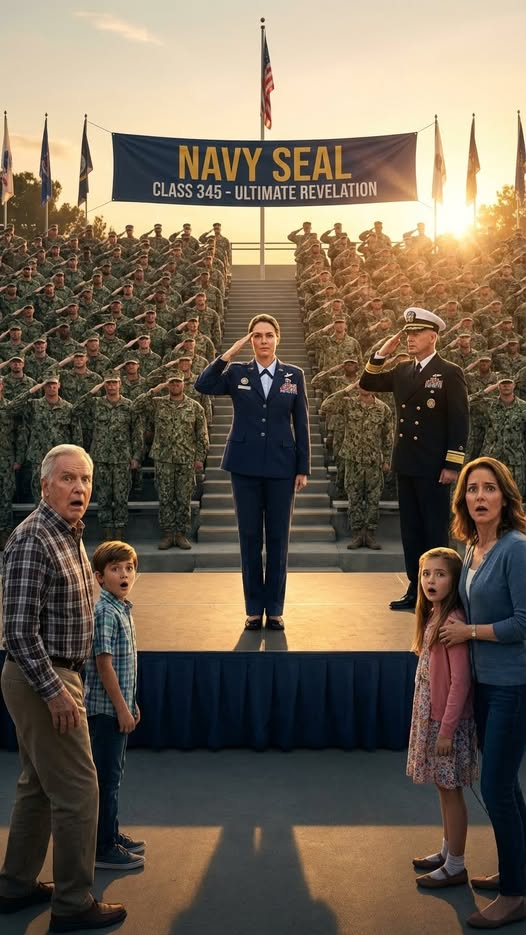
So when I stood near the back of the crowd at my younger brother’s Navy SEAL graduation, dressed in simple civilian clothing, no medals or insignia visible, I blended perfectly into expectations. I wasn’t there as someone who belonged. I was just family—watching from the sidelines.
Then everything changed.
As the ceremony concluded, a senior general stepped away from the podium. His attention moved deliberately through the crowd until it stopped on me.
“Colonel,” he said clearly. “I didn’t expect to see you here.”
The single word echoed louder than the applause.
My father froze. My mother covered her mouth in disbelief. My brother turned toward me, confusion written across his face.
To them, I was Samantha Hayes—thirty-five years old, supposedly working an ordinary administrative job, the child who had quietly exited the military years earlier. What they had never known was that I was an active-duty Colonel in Air Force Special Operations.
For over fifteen years, I lived behind a wall of silence—not out of choice, but out of necessity. Careers tied to national security are built on discretion, not recognition. Some missions demand anonymity. Some sacrifices go unseen. I endured their assumptions because the alternative was never an option.
I was raised in San Diego by a retired Navy captain. In our home, military excellence wasn’t encouraged—it was expected. The walls were filled with framed deployments, naval charts, and photographs of ships cutting through rough seas. Strategy was dinner-table conversation. Discipline was a way of life.
My brother thrived openly in that environment. I absorbed it quietly.
Before school, I ran miles. I studied military history and leadership doctrine. I trained relentlessly. When I earned my appointment to the Naval Academy, my father hugged me with a pride I had rarely felt before. It felt like belonging.
At the Academy, I excelled—academically, physically, and as a leader. Then I was approached with an offer that didn’t exist on any official path.
They weren’t recruiting a traditional officer. They needed someone who could operate without visibility.
The terms were absolute: immediate transfer, lifelong confidentiality, and a cover story designed to attract no attention at all. “Failure raises fewer questions than success,” I was told.
So I agreed.
Back home, disappointment slowly turned into quiet exclusion. Questions about what went wrong went unanswered. Eventually, they stopped asking. Family milestones came and went. My brother’s achievements were celebrated. My life became a topic politely avoided.
Meanwhile, my real career accelerated.
I trained in classified locations. I led missions that would never be publicly acknowledged. I worked across counterterrorism, intelligence operations, and cyber defense. Promotions came quickly—not because of time served, but because of results delivered.
When I became a Major, my family was celebrating my brother’s next accomplishment. When I earned commendations behind closed doors, relatives were whispering about how I never lived up to expectations.
The burden of the secret grew heavier than the job itself.
I missed holidays due to urgent deployments. I left family dinners for operations that couldn’t wait. Each absence reinforced the idea that I lacked direction or discipline. Correcting them was never permitted.
By the time I reached the rank of Colonel, I had accepted that my family might never truly know who I was.
Then came the SEAL graduation.