
In November of 2016—years after pleading guilty to felony sex-abuse charges—Jeffrey Epstein wasn’t hiding. He wasn’t taking a back seat. He was working his way into the sovereign power of the most important Muslim nation in the world.
He was pitching himself as a behind-the-scenes financial fixer to the Saudi court, in a message intended for the man who would soon consolidate power and become the central architect of Vision 2030. Epstein didn’t hedge. He didn’t whisper. He wrote like a man who expected the door to open.
Before I go any further, a quick word about how this work stays free for the world—for readers in Gaza, readers in Sudan, students, and people living in deep poverty who can’t afford paywalls. If you’re able, click here to become a member so this reporting remains free for them—and even for you, when you can’t afford to pay. And if you want to support in a way that fits your life,
Now—back to the document.
The email exchange between Epstein and the leaders of the Kingdom of Saudi Arabia, released by the Department of Justice, is straightforward and chilling because it is Epstein speaking in his own voice.
He proposes a formal role at the very top of the Saudi court:
“My suggestion is to become the Financial Confidant to the Prince / court / K.S.A whatever entity suits you.”
He presents himself as indispensable to Vision 2030, positioning his value not as advice but as control:
“I would need to review all financial components MYSELF… ministers consultants etc.”
He demands direct, recurring access:
“I would request a 30 minute skype or meeting every two weeks with the Prince.”
He offers zero pay for the first year—not as humility, but as leverage:
“At the end of the first year, the prince can decide whether to pay any amount to my firm that he sees fit. no negotiation.”
And he references the Public Investment Fund (PIF)—the crown jewel of Saudi Arabia’s economic power—asking for org charts, operations, the central bank, even the royal purse.
At the time, Epstein was a registered sex offender. He knew that. Everyone around him knew that. And still, he wrote with the confidence of a man who believed consequences were for other people.
That confidence is the story.
Because this wasn’t a drunk email. It wasn’t a joke. It wasn’t a fantasy. It was written, translated, transmitted, and archived. Someone took it seriously enough to move it along.
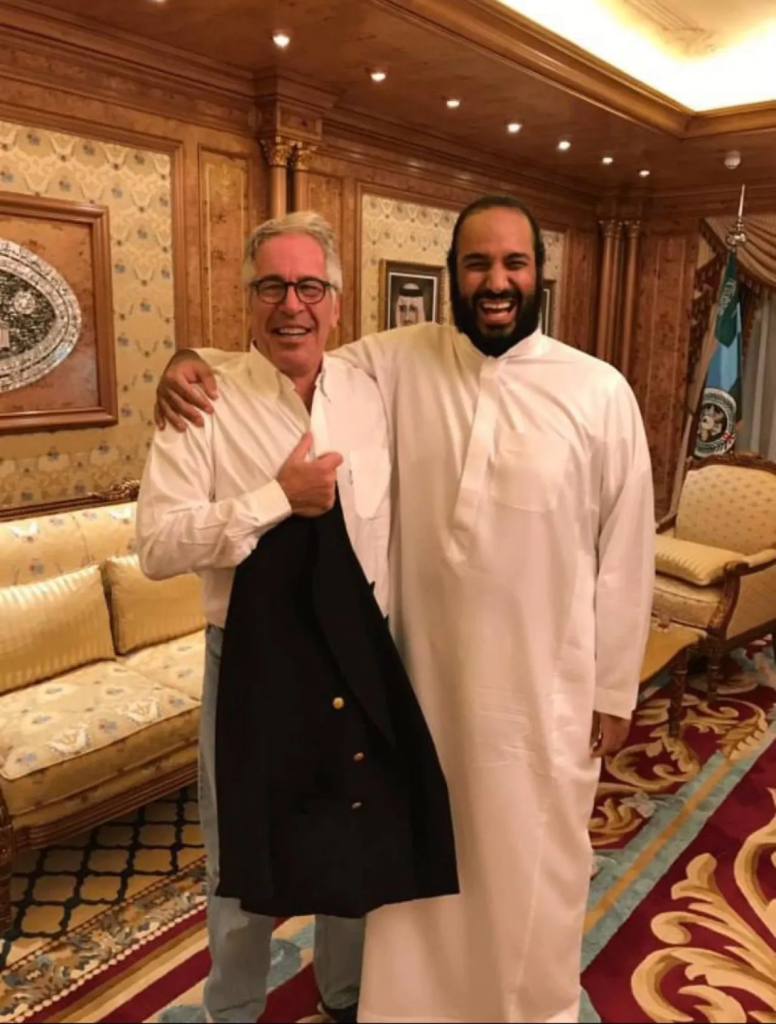
The DOJ release also includes a photograph of Epstein inside a lavish Saudi interior, smiling broadly beside the Saudi Crown Prince MBS. And for many of my Muslim readers, what stands out immediately is how unusual the image is—I don’t think I’ve ever seen him without his head covered until this image. And I don’t think I’ve ever seen him look this happy. These men look like dear friends. I don’t think I’ve ever seen someone be so happy around MBS.
That doesn’t prove an arrangement. It doesn’t confirm a deal. But it does tell us something important about access—about comfort, proximity, and how Epstein moved through elite spaces even after his crimes were known.
Here’s the question that matters, and I’ll ask it plainly, without embellishment:
Did this arrangement, or one like it, get made?
That’s it. That’s the whole thing.
Not what did Epstein want?—he told us.
Not why was he so confident?—we can infer that from a lifetime of impunity.
But whether the pitch succeeded in some form, formally or informally, on paper or in practice.
The scandal here is not that a predator sought power. Predators always do.
The scandal is that he felt safe doing it—safe enough to put it in writing, to demand access, to request control, to ask for the keys to a sovereign wealth machine.
Jeffrey Epstein didn’t disappear after his conviction. He auditioned. And powerful systems kept letting him read.
What’s also striking is how Epstein sells himself. The “zero pay” offer isn’t generosity—it’s strategy. Anyone who has spent time around elite finance understands this move immediately. It’s a way of saying: I don’t need your money. I want your trust, your access, and your discretion. It’s how influence is purchased without a receipt. Epstein understood that the real currency here wasn’t a salary—it was proximity to power and control over flows of capital so vast they don’t even register as numbers anymore.
Equally telling is his insistence on reviewing everything himself—ministers, consultants, financial architecture. This is not the posture of an advisor. It’s the posture of a gatekeeper. Epstein wasn’t offering ideas; he was offering to stand between a kingdom and the rest of the world, to be the man who “knows how Wall Street will try to play.” That kind of role only exists when someone believes they can operate above scrutiny, beyond oversight, and outside normal accountability structures.
And then there’s the part that’s easy to miss but impossible to ignore: the translation, transmission, and preservation of this message. This wasn’t a discarded email that went unread. The Arabic version was delivered. The exchange was maintained. It survived long enough to land in a DOJ release years later. That alone tells us this wasn’t treated as absurd or unserious.
This is why the question matters. Not because it feeds speculation, but because it forces clarity. If no arrangement was ever made—formal or informal—then that should be easy to say, document, and confirm. And if something was made, even briefly, even partially, even through intermediaries, then the public deserves to understand how a convicted sex offender continued to circulate at the highest levels of global power as if nothing had happened at all.