
The Seattle Seahawks delivered a commanding performance on Sunday night, relying on a relentless defense to overwhelm the New England Patriots in Super Bowl LX.
It was a decisive victory—one that should have dominated headlines.
Instead, much of the postgame conversation shifted away from football and toward a heated political and cultural controversy sparked by Donald Trump.
A Halftime Show That Divided Viewers
The Super Bowl halftime show, headlined by global music icon Bad Bunny, became the center of attention almost immediately.
The Puerto Rican superstar, whose real name is Benito Antonio Martínez Ocasio, took the stage at Levi’s Stadium on February 8 with a visually striking, high-energy performance rooted in Latin culture. The set featured Spanish-language hits, elaborate choreography, and a dramatic stage design that included performers moving through a field of sugarcane.
The show also included surprise guest appearances by Lady Gaga and Ricky Martin, adding to the spectacle of one of the most watched live television events of the year.
Inside the stadium, fans responded with enthusiasm. Across social media platforms, many viewers praised the performance for its creativity, representation, and production value.
But not everyone shared that reaction.
Trump’s Social Media Response
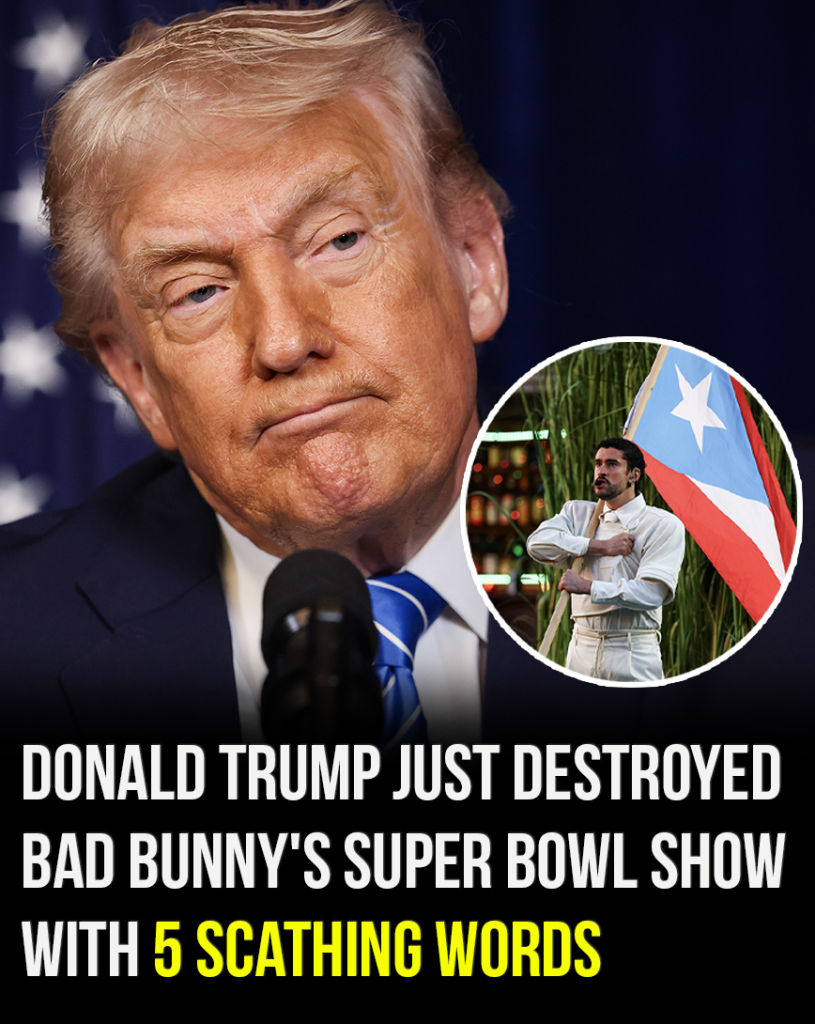
Shortly after the game, former president Donald Trump posted a lengthy critique on Truth Social, sharply condemning the halftime show.
In his post, Trump described the performance as “one of the worst” in Super Bowl history, arguing that it failed to reflect what he called American standards of excellence and creativity. He also criticized the use of Spanish lyrics, stating that many viewers would not understand the performance, and objected to the choreography, claiming it was inappropriate for a family audience.
Trump further suggested that the show would receive favorable coverage from major media outlets despite what he viewed as widespread public disapproval. He concluded his post by pivoting to unrelated topics, including praise for economic performance during his administration and criticism of the NFL’s new kickoff rule.
Notably, Trump did not attend the game, previously saying the event was too far for him to travel.
Cultural Messaging at the Center of the Debate
The criticism was not entirely unexpected, given the themes embedded in Bad Bunny’s performance.
As the show concluded, a large illuminated message appeared in the stadium reading:
“The only thing more powerful than hate is love.”
The final visual featured Bad Bunny holding a football, surrounded by Latin American performers. Printed on the ball were four words that quickly circulated online:
“Together we are America.”
For many viewers, the moment was seen as a message of unity and inclusion. For others, including Trump, it became a point of controversy.
From Sports to Political Firestorm
What began as a championship football game quickly evolved into a broader national discussion involving sports, entertainment, politics, and cultural representation.
As reactions continue to pour in from fans, analysts, and public figures, the Super Bowl LX halftime show has secured its place as one of the most talked-about performances in recent NFL history—proving once again that the Super Bowl is about far more than just the game.